The Lysefjord sights, in the order you pass them
Every boat trip from Stavanger follows roughly the same line into the Lysefjord and back. The landmarks come in a fixed order, and knowing it helps you pick your spot on deck and the moment to stand up. This guide walks the route from the harbor to the waterfall, then covers what lies beyond the turning point.
Out of the Vågen harbor
All five trips we compare cast off from the Vågen, the narrow harbor at the heart of Stavanger. The first sight comes before the boat has even picked up speed. Rows of white wooden wharf houses line the quay, and on the west side the lanes of Gamle Stavanger (Old Stavanger) climb the slope, packed with white timber cottages from around 1800.
Fjord Xplore's route names two more harbor landmarks. You pass Tollboden, the old customs building, then the Norwegian Petroleum Museum with its oil-rig styling by the water. Its boat then slips under the city bridge before turning toward the fjord.
Crossing to the fjord mouth
The Lysefjord does not start at Stavanger. Boats need about 30–45 minutes to reach it. On the way southeast they thread between low islands and farmland. This is the most open water of the trip, so it is where a RIB bounces most and where the wind bites on deck. Helgøy's listing names Ådnøy, an island near the approach, as one of its points along the way.
Some passengers on the 3.5-hour Rødne trip found this stretch long and slow, and a few said 2 hours on the water would have suited them better. Use it to find a good place on deck before the cliffs begin.
Under the Lysefjord bridge
The suspension bridge across the mouth of the fjord near Forsand opened in 1997, and both Rødne and Fjord Xplore list it as a highlight of the way in. Pass beneath it and you are in the Lysefjord proper. The sea floor here rises to a sill only about 13 m (43 ft) deep, while farther in the water drops to more than 400 m (1,300 ft).
Lysefjorden runs 42 km (26 miles) inland, and its granite walls climb to about 1,000 m (3,300 ft) on either side. The name means light fjord, usually explained by the pale color of that granite.
Fantahålo, the Vagabond's Cave
Not long after the bridge comes a dark slot in the cliff called Fantahålo, known in English as the Vagabond's Cave or the Vagabond's Hole. It is less a cave than a narrow gap where the rock has split. Fant is an old Norwegian word for a wandering vagrant, and the story goes that one such man once lived in the cleft. Helgøy's listing promises a local legend told on board, so each crew has its own take.
The stops at the cave are short. FjordEvents lists a 5-minute photo pause, while Brim's summer ship quotes about 15 minutes at each sight. A small boat can nose in closer to the gap than a big catamaran, which is one of the few places where the RIBs win on views alone.
Preikestolen from the water
The headline sight is Preikestolen (Pulpit Rock), a flat-topped block of granite that stands 604 m (1,982 ft) above the fjord. From a boat you look straight up at it. The famous platform appears as a square shelf jutting from the wall, and on a clear day you can make out hikers on its edge, small as ants. Every boat on our list stops beneath it for photos.
Seeing it from below is quite another experience from standing on top, which takes a hike of about 4 hours there and back. Our guide to Pulpit Rock from the fjord compares the two, and the photography guide explains how to fit the cliff and the people on it into one frame.
Closest to the falls on a big boat
Helgøy's 2.5-hour catamaran (from ~$89) backs in to within about a meter of Hengjanefossen, and it keeps a heated indoor lounge for the ride home.
Hengjanefossen, the Whisky Falls
The last big sight is Hengjanefossen, a waterfall that tumbles off the cliff into the fjord. Boat crews and the listings call it the Whisky Falls (sometimes Whiskey Falls). Figures for its height vary widely between listings, from 75 m (250 ft) up to about 400 m, so treat any number with care. What matters more is how close you get.
- The RIBs. FjordEvents' RIB at ~$124 promises a "shower" under the spray. Stavanger RIB at ~$145 invites passengers to drink from the falls;
- Helgøy. The catamaran reverses until its stern is about a meter from the falling water;
- Fjord Xplore. Its covered adventure boat at ~$166 pushes its bow into the falls;
- Rødne. The electric catamaran at ~$92 brings you up close, though its listing gives no distance.
The flow depends on the season. Snowmelt in spring and heavy rain at any time turn it into a roaring curtain, while a dry spell in late summer can thin it out. Our month-by-month guide covers the timing, and the RIB crews hand out waterproof suits for a reason.
Goats and wildlife along the shore
Some of the most photographed locals in the fjord are goats. On Rødne's trips a pair named Gunnar and Sigve come down to the boat in spring and summer. Stavanger RIB reviewers have met two others, known as Salt & Pepper, on the rocks by the water. Neither pair keeps a timetable, so treat a visit as a bonus.
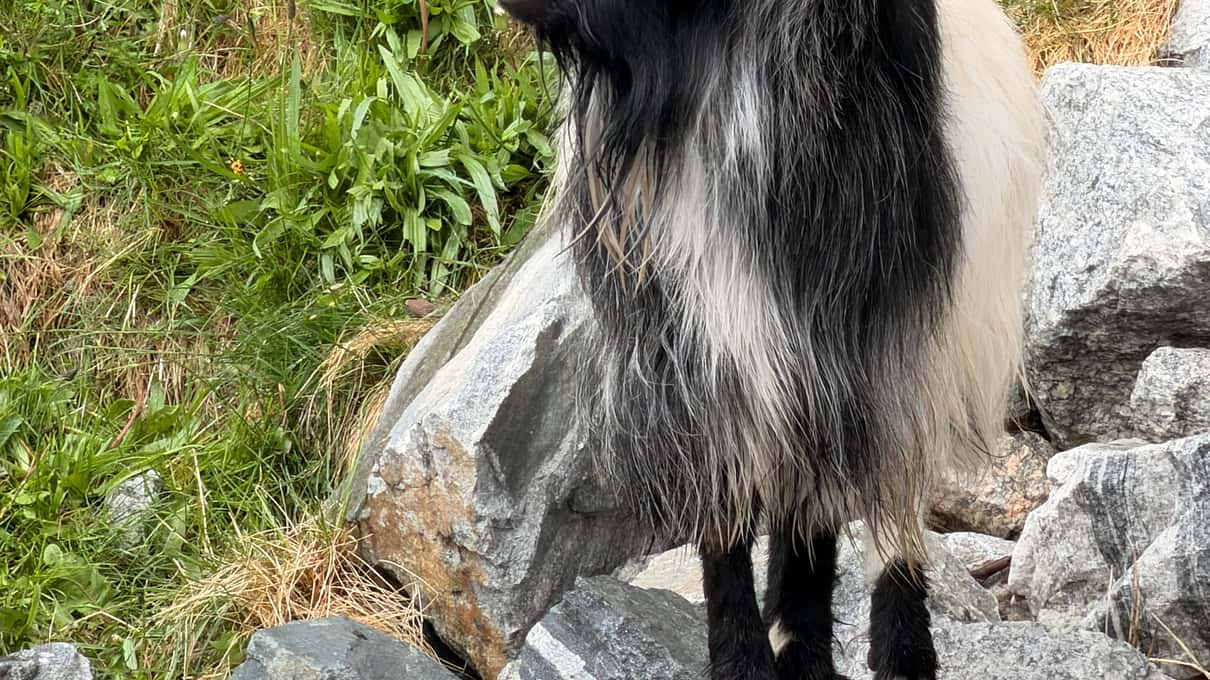
Wildlife is a matter of luck. White-tailed eagles hunt along the cliffs, and they are the largest birds of prey in Norway. Rødne's listing adds seals and porpoises as possible sightings. Stavanger RIB builds 45 minutes of sightseeing and wildlife spotting into its 2-hour trip, and its reviewers mention seals. One FjordEvents reviewer saw no animals at all, which is how it goes on some days.
What the boats do not reach
None of the trips on this site goes the full length of the fjord. They turn for home after Hengjanefossen, and Brim's reviewers report that their ship turns about halfway in. That leaves the inner fjord out of reach.
- Kjerag. The mountain rises to 1,110 m (3,642 ft) near the head of the fjord. Its famous boulder, wedged in a crack high above the water, lies far beyond the turning point, and hikers reach it from the road above Lysebotn;
- Flørli. The tiny settlement known for a wooden stairway of 4,444 steps beside an old power station pipeline sits too far in;
- Lysebotn. The village at the very end of the fjord, where a road climbs out in a stack of hairpin bends, is far past the point where these boats turn.
Seeing the inner fjord from the water takes a much longer sailing, which falls outside this comparison. For the trips themselves, the guide to choosing between a RIB and a cruise boat helps you pick the ride, and the cost guide lines up every price.
How long you spend among the sights
The route is the same on every boat, but the time spent on it varies a lot. The RIBs take about 30 minutes each way to and from the fjord, which leaves under an hour among the sights on a 2-hour trip. FjordEvents also opens with a 15-minute safety briefing on the quay, and Stavanger RIB lists 45 minutes of sightseeing.
The big boats are slower but linger. Rødne takes 3.5 hours for the round trip. Helgøy needs 2.5 hours, as does Fjord Xplore from its boathouse. Our weather and cancellations guide explains what low cloud can hide if the weather turns, and what happens to your booking.